1. Even a busy rental is empty in winter
80% occupancy is a strong year for a short-term rental. It still leaves 73 empty nights, and they aren't spread evenly. Summer and the holidays fill up, while January to March are the slow months. In our example, 60 of the 73 empty nights fall between November and March, the months when heating costs the most.
| Month | Empty nights (example) |
|---|---|
| November | 12 |
| December | 8 (the holidays are busy) |
| January | 16 |
| February | 13 |
| March | 11 |
| November–March | 60 |
| Rest of the year | 13 |
So "we're booked 80% of the time" doesn't mean heating an empty house is a small cost. The empty nights land in the most expensive months.
2. The math for one empty day
A house loses heat in proportion to the difference between the indoor and outdoor temperature. Halve that difference and you roughly halve the heating bill. Our example uses:
- The house: 1,500 sq ft, electric baseboard heat, built before the 1990s. It loses about 400 BTU an hour for every °F of difference between inside and outside. Newer, tighter homes lose less.
- Electricity: Seattle City Light's 2026 residential rate of 13.38¢/kWh. The daily base charge stays the same whatever the temperature, so we leave it out.
- Weather: Seattle's average temperature for each month (1991–2020 normals), from 41°F in December to 46°F in March.
| Month | Average outside | Empty at 70°F | Empty at 55°F | Saved per empty day |
|---|---|---|---|---|
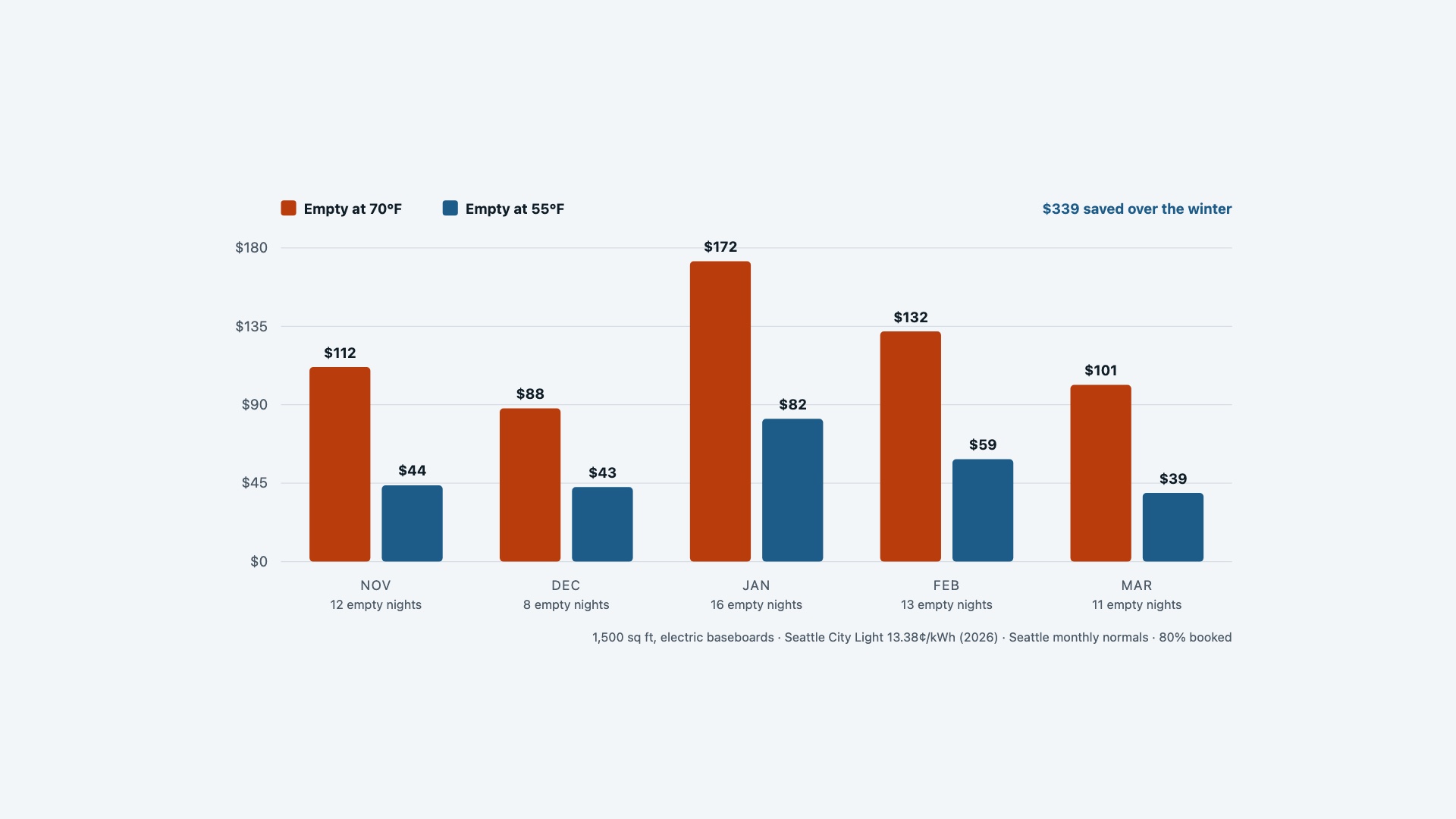
| November | 45°F | $9.30 (70 kWh) | $3.65 (27 kWh) | $5.65 |
| December | 41°F | $10.99 (82 kWh) | $5.35 (40 kWh) | $5.65 |
| January | 41°F | $10.77 (80 kWh) | $5.12 (38 kWh) | $5.65 |
| February | 43°F | $10.16 (76 kWh) | $4.52 (34 kWh) | $5.65 |
| March | 46°F | $9.22 (69 kWh) | $3.58 (27 kWh) | $5.65 |
The saving is the same every month. It comes from the 15° difference between 70°F and 55°F, not from the weather. On a 25°F day during a cold snap, the empty house costs about $17 at 70°F and $11 at 55°F, and the saving is still $5.65.
3. What it adds up to over a winter
| Baseboards | Mini-splits (heat pump) | |
|---|---|---|
| Heating 60 empty winter days at 70°F | $605 | $242 |
| Heating them at a lower temperature instead | $267 (at 55°F) | $161 (at the lowest setting, about 61°F) |
| Most you could save | $339 | about $80 |
| More realistic saving (warming up a day before each check-in) | about $225 | about $55 |
Two things make the realistic number smaller:
- The house has to be warm before guests arrive. Warming it up about a day before each check-in means the last empty day of each gap isn't saved. With an average gap of 3 nights, about a third of the empty days are spent warming up.
- Heat pumps are already efficient. A mini-split delivers about 2.5 units of heat for each unit of electricity in a Seattle winter. Most units also won't heat below about 60°F, so there's less to save.
Per property, that's a few hundred dollars a winter with baseboards. Across 10 rentals, it's over $2,000, for money spent heating rooms with nobody in them.
4. Why not turn the heat off completely?
Because the next number is much bigger. According to the Insurance Information Institute, the average homeowners claim for water damage and freezing was about $15,400 (2019–2023). Pipes in outside walls, crawl spaces and under sinks freeze first. A burst pipe in an empty rental can run for days before your cleaner finds it, and then you're also cancelling bookings.
Western Washington gets a few hard freezes most winters, and mountain and foothill cabins get many more. Leave the heat on, at a low setting:
- Don't go below 55°F. The American Red Cross advises keeping the heat at no lower than 55°F when you're away in cold weather. Some insurers ask for more, and some policies have rules for vacant homes, so check yours.
- Check the cold spots. Leave cabinet doors open under sinks on outside walls, and insulate pipes in crawl spaces.
- Know when the heat goes off. A tripped breaker or a dead thermostat makes a low setting irrelevant. You need an alert, not a surprise.
Holding an empty house at 55°F for the whole winter costs about $267 in our example. Compared with a $15,400 claim, that's cheap insurance.
5. Guests still need to walk into a warm house
Saving money on empty days only works if the house is warm at check-in. A cold arrival leads to a refund request and a bad review, and in winter that's when guests notice it most.
- Baseboards bring rooms from 55°F to 70°F in about an hour or two, longer for the walls and furniture to warm through. The air feels warm well before the house is.
- Mini-splits take longer at full speed, and that's also when they're least efficient, so start them earlier.
- Warming up isn't expensive. Bringing the house from 55°F back to 70°F takes roughly 15–20 kWh, about $2–3, which is less than one day of the saving.
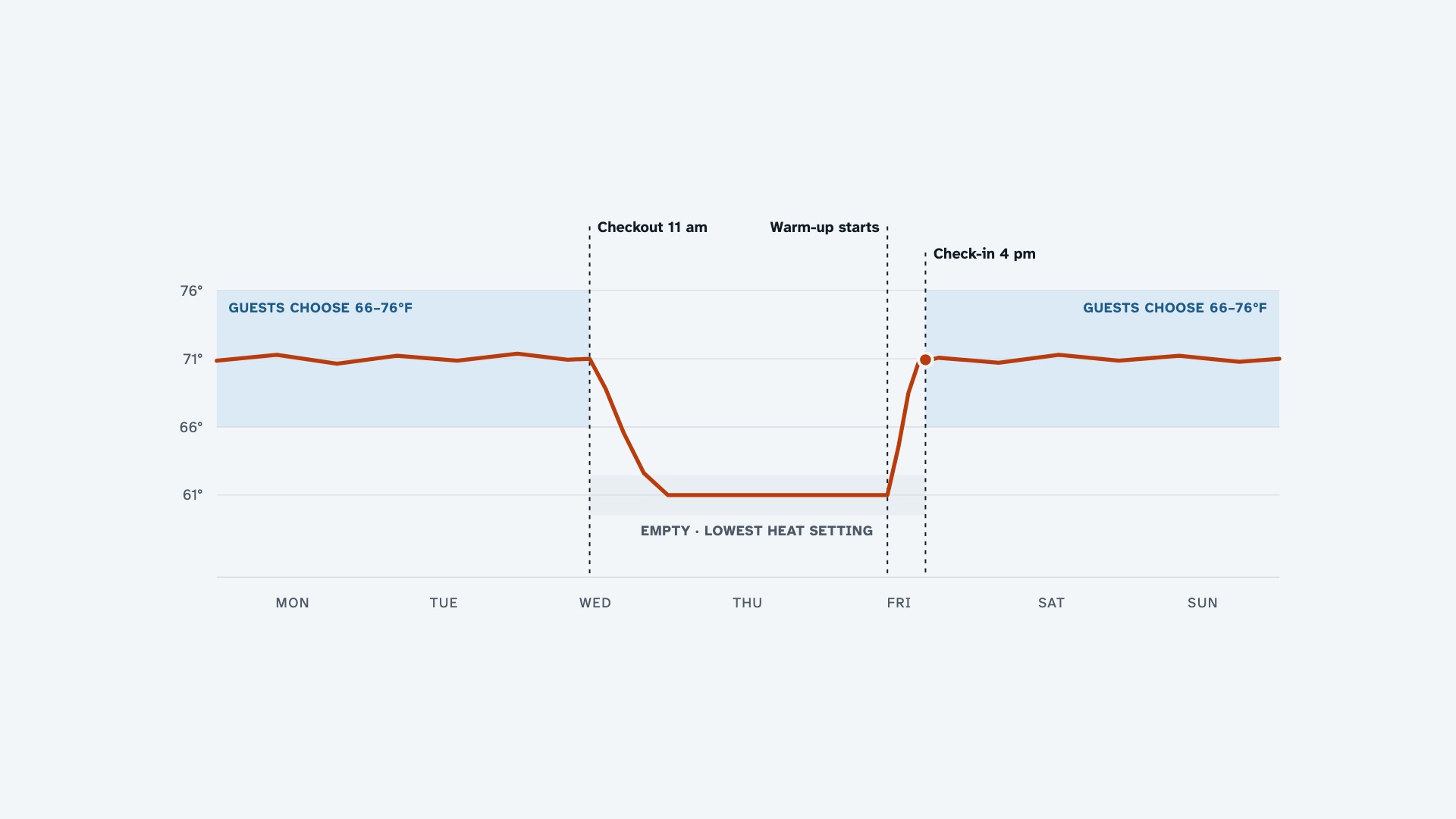
The pattern that works is to drop to 55°F after checkout, hold it while the house is empty, and start warming up within a day of the next check-in.
6. Do the math for your own rental
Your house won't match our example exactly. To estimate yours:
- Find your heating kWh. Compare a winter bill with a summer bill. The difference is roughly your heating.
- Divide by the days in the billing period to get heating kWh per day at your usual temperature.
- Estimate the saving. In Seattle's winter, dropping an empty house from 70°F to 55°F cuts that by a little over half. Multiply the saving by your rate and your empty winter days.
For example, a cabin using 2,400 kWh of heat in a 30-day January uses 80 kWh a day. Dropping it to 55°F while empty saves about 42 kWh a day. At 13.38¢ that's about $5.60 a day; at a higher rate, it's more.
7. How STR Spark does this for you
STR Spark reads your bookings from Hospitable, Hostaway or your Airbnb, Vrbo and Booking.com calendars, and handles the setback for each one:
- Drops to 55°F after checkout on Mysa baseboard and in-floor thermostats, and to the lowest heat setting on mini-splits.
- Warms back up before check-in, so guests walk into a warm house.
- Never lets the house drop below the frost floor you choose, and switches the heat back on if a guest left it off.
- Emails you if a device stops responding, for example after a tripped breaker or a Wi-Fi outage, so a cold house doesn't go unnoticed.
- Makes no changes if it can't read your bookings.
It costs $5/month per live listing, and your first 3 months are free. In our example, that's about $25 for the winter, against about $225 saved on one baseboard-heated property.
Start with a dry run
Every property starts in a dry run. You can see exactly when STR Spark would set back and warm up each room for your upcoming bookings before it changes anything. Connect your calendar and try it free.